Home physiotherapy in Srinagar: what to expect in your first session
By Kashmir Health Collective
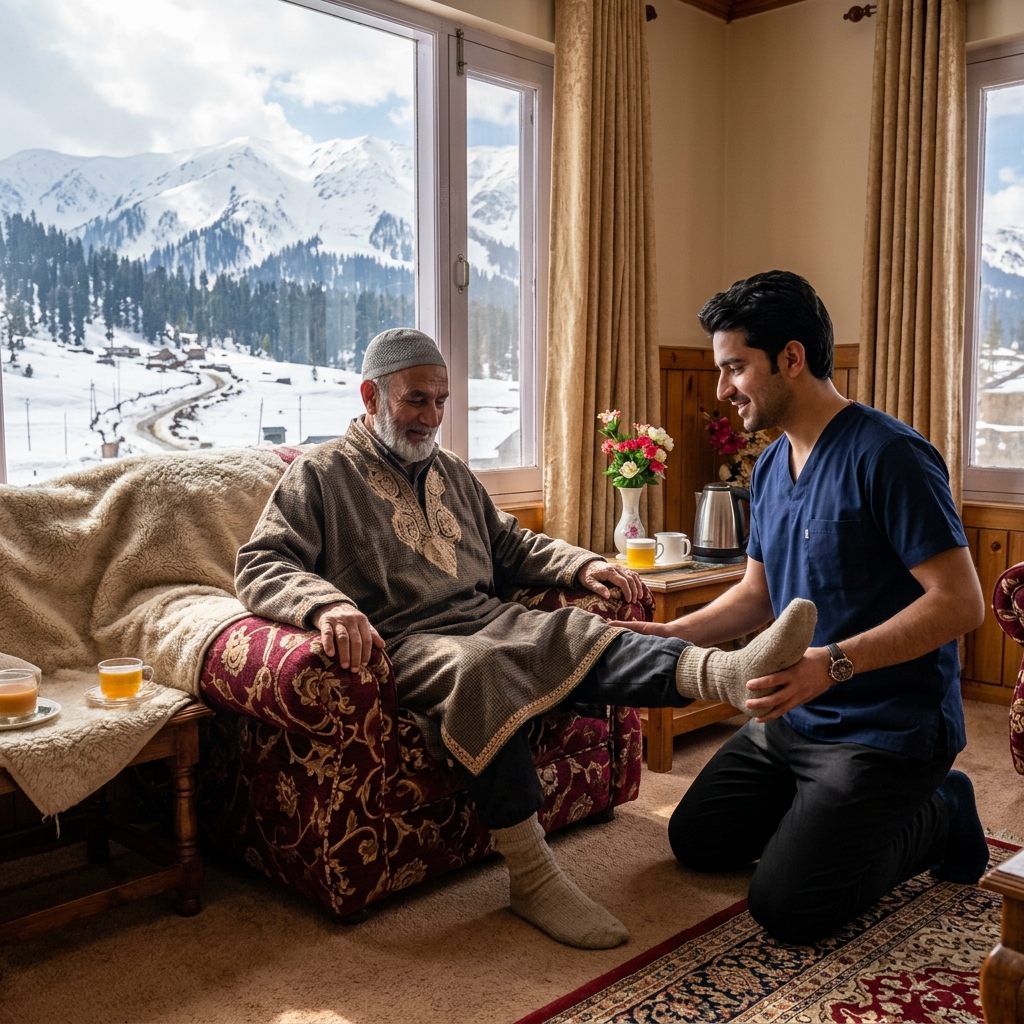
Assessment, safety checks, and exercise planning for your first doorstep physiotherapy session in Srinagar — plus how to prepare your home.
Choosing physiotherapy at home means exercises happen on your actual stairs, bathroom, and bedroom floor — not a clinic mat that looks nothing like daily life. This guide walks through the first session so Srinagar families know what to prepare and what outcomes are realistic.
Before the therapist arrives
Clear a two-metre space with stable footing. Have surgical discharge notes, imaging summaries, and medication lists ready. Wear comfortable clothing that allows knee and shoulder examination. If the patient had recent surgery, confirm surgeon clearance for weight-bearing.
Book through book a visit and select your neighbourhood — Rajbagh, Hyderpora, Hazratbal, and dozens of other areas are supported. You receive provider confirmation before the appointment.
Assessment: what therapists measure
The first visit is primarily evaluation. Therapists observe posture, gait, balance, joint range, swelling, and pain responses. They ask about goals: return to walking, climbing mosque steps, lifting grandchildren, or returning to office work.
Neurological patients after stroke may need tone and coordination testing. Orthopedic patients after fracture or joint replacement need surgical protocol alignment. Therapists document baselines so progress is measurable across weeks.
Pain, safety, and red flags
Some soreness during exercise is normal; sharp or radiating pain is not. Therapists stop movements that threaten healing structures. They teach family members safe assist levels — when to guard a shoulder and when not to pull.
Fever, calf pain, chest symptoms, or sudden weakness are medical flags, not physiotherapy issues alone. Therapists may pause exercise and advise physician contact.
Equipment you may already own
Therapists often use resistance bands, steps, chairs, and pillows found at home. They may suggest inexpensive aids after assessment. You do not need a clinic-grade gym. Kashmir homes with narrow stairs benefit from task-specific drills.
The exercise plan and homework
Expect a small set of exercises repeated daily between visits. Compliance matters more than exotic machines. Therapists demonstrate, watch family caregivers copy techniques, and leave written or photographed instructions when possible.
Session frequency depends on diagnosis — post-operative knees may need several weekly visits early; chronic pain may stabilise with fewer visits. Discuss realistic duration at the first appointment.
Combining physiotherapy with nursing
Bedbound or post-operative patients may need nursing for wounds or vitals the same week. Coordinate schedules through one platform. Read post-surgery recovery at home and stroke rehabilitation for combined pathways.
Srinagar-specific practical tips
Winter floors can be cold — patients may need socks with grip. Power cuts should not leave stairs dark during exercise practice. If pollution is high, ventilate between sessions rather than during heavy outdoor exertion; see respiratory home care.
Rural families in Baramulla, Budgam, and Ganderbal should confirm access roads when snow is forecast so sessions are not missed repeatedly.
After session one: documentation and follow-up
Note pain levels, sleep, and mobility changes in a notebook. Share updates at visit two. If progress stalls, therapists adjust load — recovery is iterative, not linear.
Browse providers to compare physiotherapist experience — orthopedic, neurological, geriatric, and pediatric skills differ. Our about standards explain credential checks behind each listing.
Booking your next visits
Consistent weekly slots outperform sporadic intensive bursts. Use the same booking flow to extend packages after the first successful visit. Link related journal guides from our journal index when family members want deeper reading.
If you are comparing home physiotherapy with clinic care, remember travel risk during Chilla Kalan and the advantage of practicing on your own steps. Many knee and hip patients across Kashmir now complete most rehab at home with verified clinicians.
Pair this guide with how to book a home nurse when post-operative patients need nursing and physiotherapy the same week.
Many Srinagar families keep a printed recovery checklist on the bedroom wall: morning medications, dressing time, permitted walking distance, and emergency numbers. Nurses review the checklist during the first visit and correct outdated items left over from hospital instructions. This simple habit prevents the common mistake of continuing pre-surgery drug doses after discharge.
Orthopedic patients often underestimate swelling in the first week. Elevating the operated leg above heart level for prescribed intervals, icing per surgeon protocol, and wearing compression when advised reduce pain more reliably than increasing oral analgesics alone. Physiotherapists coordinate elevation timing with exercise so swelling and movement both improve.
Abdominal surgery patients need cough support and incision bracing when clearing secretions. Family members should learn the hands-on brace technique during the nurse visit rather than improvising during a nighttime cough episode. Persistent wet cough, green sputum, or fever warrants physician review for chest infection.
Children and elderly patients may not report pain clearly. Watch for agitation, refusal to move, poor sleep, or loss of appetite as indirect signals. Nurses help families translate these signs into actionable messages for surgeons during telehealth follow-up when roads are difficult.
If the patient uses anticoagulants after certain procedures, bruising and oozing at the wound site need closer observation. Never stop or adjust anticoagulants without written physician guidance. Sudden headache, weakness on one side, or slurred speech require emergency assessment regardless of recent surgery type.
Home recovery in multi-generational households works best when visitors are brief and hygiene rules are consistent. Ask guests to wash hands, avoid sitting on the patient bed, and postpone visits when they have colds. Winter gatherings are culturally important but can introduce infection to vulnerable post-operative patients.
District towns across Baramulla, Budgam, and Anantnag share the same clinical risks as Srinagar city even when specialist clinics are farther away. Scheduling nursing before long weekends or forecast snow keeps dressings on track when outpatient units reduce hours.
Families sometimes receive conflicting advice from well-meaning relatives. Use the surgeon discharge sheet and nurse documentation as the single source of truth. When traditional remedies are suggested, ask the treating team before application to surgical sites or before stopping prescribed medicines.
Sleep disruption is common after anesthesia and hospital stays. Dim evening lighting, reducing caffeine, and keeping pain controlled before bed improve rest. Daytime naps are fine early in recovery but long afternoon sleep can confuse night routines for elderly patients.
Driving, kitchen work, and lifting heavy kangri pots should stay off limits until cleared. Patients often feel mentally sharp while the body is still healing. Reinforce activity restrictions verbally during each family shift change so no single caregiver accidentally allows unsafe tasks.
Telehealth follow-up complements home visits when bandwidth allows. Prepare weight, temperature, wound photos if requested, and a list of three questions before the call. Home nurses can measure vitals immediately beforehand so the call is data-rich rather than vague.
Insurance paperwork, employer letters, and disability forms sometimes require clinician signatures. Ask during booking whether your nurse can document functional status facts without overstating scope. Keep forms in the same folder as medical records to avoid last-minute searches.
Spiritual practices remain central for many Kashmir families. Work with clinicians to find safe positions for prayer, ablution with assistance, and seated rituals while standing balance is limited. Physiotherapists often incorporate meaningful daily tasks as functional goals.
Appetite returns gradually. Favour dal, eggs, yoghurt, soft vegetables, and familiar rice dishes over heavy greasy feasts that upset the stomach after anesthesia. Diabetic patients still need carbohydrate consistency — coordinate festive meals with nursing or dietitian advice when available.
Pets and indoor birds can affect respiratory patients and wound environments. Keep animals out of the recovery room and change bed linens promptly if pet hair is present. This is especially relevant in homes with hamams where humidity and hair accumulate.
When patients improve, taper home support deliberately rather than stopping all at once. A final nursing visit for closure documentation helps families know which observations to continue alone. Book follow-up physiotherapy milestones if orthopedic goals are not yet met.
Second opinions are reasonable for slow healing. Home nurses document objective findings families can show another surgeon without repeating guesswork. Maintain courtesy between teams — summaries should be factual, not argumentative.
Power banks, charged phones, and saved offline maps matter when winter trips to emergency units are possible. Store the nearest facility accepting surgical emergencies and keep cash or cards accessible if digital payments fail during outages.
Young adult patients recovering in parental homes need privacy and autonomy balanced with safety. Discuss bathroom independence, dressing privacy, and visitor boundaries openly to reduce stress that can slow participation in rehab.
Recovery diaries help: date, pain score zero to ten, sleep hours, bowel movement, wound note, and exercise done yes or no. Patterns over seven days guide whether to escalate or continue the current plan.
If drains or tubes remain at discharge, nurses teach emptying, measurement, and skin care around entry sites. Never pull tubes without instruction. Sudden pain, fever, or fluid colour change around drains needs urgent review.
Language barriers between clinicians and elders are common. Book providers who speak Kashmiri or Urdu when possible and keep a bilingual family member on the first visit for translation of nuanced instructions.
Families across Kashmir can book verified nursing and physiotherapy through Kashmir Health Collective before winter travel becomes difficult.
Families across Kashmir can book verified.